Tidehaven
An island where the systems affect each other.
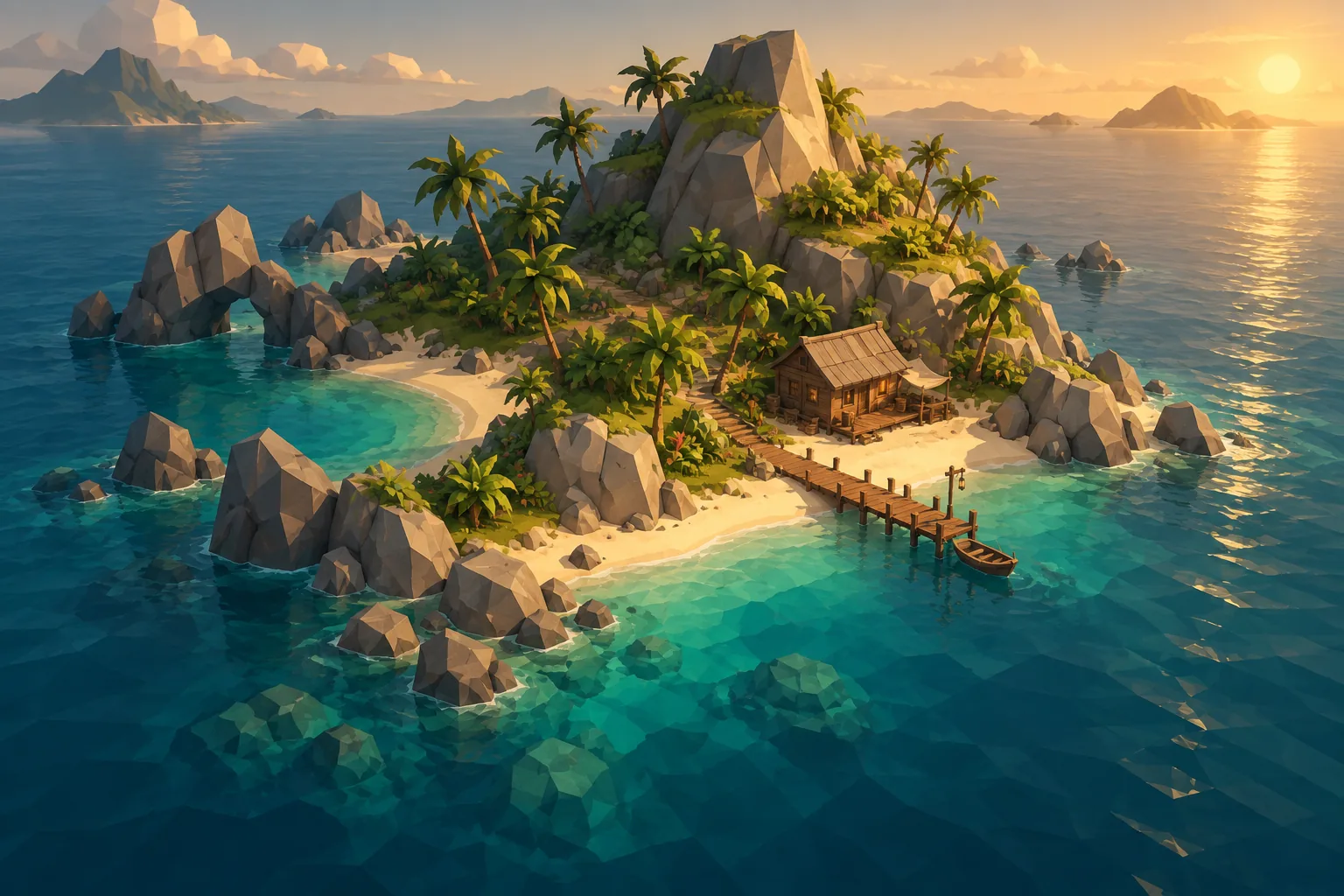
A browser survival game with finite harvesting, tool wear, crafting, construction, wildlife, and a world that persists between sessions.
- Status
- Browser prototype
- My role
- Direction, implementation & review
- Explore
- Open Tidehaven
The brief
I wanted a browser island game where gathering, crafting, shelter, wildlife, and survival needs affect each other. Harvesting changes the island, tools wear out, production takes time, and a camp becomes a record of the player’s decisions. I directed the product and AI-assisted implementation, then used targeted feedback and reproducible checks to investigate where the systems broke down.
My contribution
- Shape the progression from basic resources and stone tools into metal crafting, production queues, and a developed camp.
- Connect repeated harvesting, finite resource stocks, tool wear, inventory, and construction so actions change the world state.
- Develop wildlife behavior and a world populated with 591 resource nodes and 61 individual animals.
- Preserve inventory, buildings, resource depletion, and production state across sessions, including compatibility with earlier version-1 saves.
- Iterate on accumulated mouse input, pointer-capture fallback, sensitivity controls, and menu pause behavior.
The experience, step by step
- Explore & gather
Find resources and wildlife. Repeated harvesting consumes finite stocks and wears tools.
- Craft & build
Use recipes, production queues, and building plans to develop a camp.
- Save & return
Keep the changed island, inventory, and production state for the next session.
Decisions that shaped the product
Make progress change the world
Resource depletion, tool wear, and production queues make gathering and crafting connected decisions. A player’s inventory and camp should reflect what they have done, rather than acting as independent interface counters.
Treat old saves as part of the interface
Persistence includes more than a save button. The build preserves earlier version-1 saves while retaining newer building, production, and resource state. A returning player should be able to continue their world through an implementation change.
Load the game when someone chooses to play
Tidehaven stays in a standalone browser build. Its 3D engine and game assets load when the visitor opens it, while the portfolio remains focused on project navigation and evidence.
Reproduce an overlap, then reduce the scene cost
The embedded development report documents matched synthetic sessions that exposed accepted building placements overlapping obstacles. The recorded repair removed 237 accepted overlaps in that sample. A separate geometry change reduced a cabin from 130 mesh objects to three while preserving the triangle count. These are concrete system improvements, with a defined test scope.
Explore the work
Open the standalone build
The game includes its development and verification report. Its recorded checks cover 20,000 paired synthetic sessions and 110,087 save/load checks per run; these are automated simulation records, not human-player or GPU benchmarks.
Explore TidehavenExplore related tool experiments
The lab contains smaller demonstrations of state, review queues, journals, and calculations that show other sides of my product work.
Browse the labWhere it stands
A substantial browser game prototype with connected exploration, crafting, construction, wildlife, and persistent state. The embedded report documents system regressions and save compatibility. Gameplay requires WebGL; this review environment can verify the unsupported-graphics recovery path, while a hardware-accelerated human playthrough remains a release check.
Next case study
Teresa Comstock Real EstateHave a similar problem to work on?
Talk with me